Earliest London
- People were living around the future site of London thousands of years before London existed. A fragment of a human skull found on the Thames foreshore has been dated to around 3600 BCE — more than 5,500 years ago.
- London itself began with the Romans. Londinium was established around AD 43–50, close to a point where the Thames could be bridged, giving the new settlement excellent connections by both road and river.
- London’s first bridge was probably built within its first decade. Archaeological evidence suggests a bridge across the Thames was in place by around AD 52, helping to determine where the Roman city grew.
- London was less than 20 years old when it was destroyed by Boudica (queen of the Iceni tribe). Londinium was burned to the ground in AD 60 or 61, but the Romans rebuilt it rapidly and the city went on to become one of the most important settlements in Roman Britain.
- Britain’s oldest known dated handwritten document was found beneath modern London, near the MuseumsLondon Mithraeum. A wooden writing tablet discovered during recent construction work records a financial transaction dated 8 January AD 57. Other tablets from the site contain the earliest known written reference to London by name.
Transport & the Tube
- London opened the world’s first underground railway. The Metropolitan Railway began running between Paddington and Farringdon Street in 1863, with just seven stations — all of which are still in use.
- About 40,000 people rode the Underground on its first day. They travelled in first-, second- and third-class carriages hauled by steam locomotives.
- London also had the first Tube tunnel excavated using a tunnelling shield. The Science & EngineeringTower Subway beneath the Thames opened in 1870.
- The Tube map deliberately lies about geography. Harry Beck’s 1933 design was based on the circuit diagrams he drew as an electrical draughtsman; distances and directions were simplified to make the network easier to understand. London Transport initially thought it was too radical.
- “Mind the Gap” only dates from 1968. London Transport introduced the phrase as a safety warning, with sound engineer Peter Lodge providing the first recorded voice.
Big Ben, Parliament and Westminster
- Monuments & RuinsHouses of Parliament & Big Ben is technically the bell, not the clock tower. The Great Bell inside the Elizabeth Tower weighs 13.7 tonnes.
- There are 334 steps from the bottom of Elizabeth Tower to Big Ben. The tower itself is 96 metres high.
- Power & PoliticsWestminster Hall is more than 900 years old. William Rufus had it built between 1097 and 1099.
- Its roof is the largest medieval timber roof in Northern Europe. The late-14th-century hammer-beam structure spans the enormous hall without a single supporting column.
- Workmen found tennis balls in the roof of Westminster Hall in the 1920s. Parliament says there is no firm evidence that real tennis was actually played inside, so how they got there remains uncertain.
Coronations and royalty
- Royal LondonWestminster Abbey has hosted 39 coronation services since 1066, at which 40 monarchs have been crowned.
- William the Conqueror’s coronation accidentally caused a riot. When people inside Westminster Abbey acclaimed William in both English and French on Christmas Day 1066, Norman soldiers outside apparently mistook the noise for an assassination attempt and began setting nearby houses on fire.
- More than 3,300 people are buried or commemorated at Westminster Abbey, including around 30 kings and queens.
- The Coronation Chair contains centuries-old graffiti. The chair has been used at coronations for roughly 700 years, and Westminster Abbey records that mischievous schoolboys carved their names into it.
- Royal LondonBuckingham Palace has 775 rooms — including 78 bathrooms. It also contains 19 State Rooms, 52 royal and guest bedrooms, 188 staff bedrooms and 92 offices.
The Tower of London
- Beefeaters - officially known as the Yeomen Warders of the Royal LondonTower of London - got their famous nickname because they historically received generous daily rations of beef as part of their pay or privileges.
- The Tower’s first recorded prisoner was also its first recorded escapee. Ranulf Flambard, Bishop of Durham, was imprisoned there and subsequently escaped.
- The Tower is still ceremonially locked every night. The What’s OnCeremony of the Keys has taken place for at least 700 years.
- There is a private pub inside the Tower of London. The Yeoman Warders have their own club, commonly known as The Keys.
- The Tower once contained a royal menagerie, which included lions and a polar bear. In 1831, the Crown’s animal collection there was transferred to the Zoological Society of London.
Bridges, engineering and the Great Fire
- There are 35 bridges, 9 rail tunnels, 5 road tunnels and 2 foot tunnels across the Thames in London.
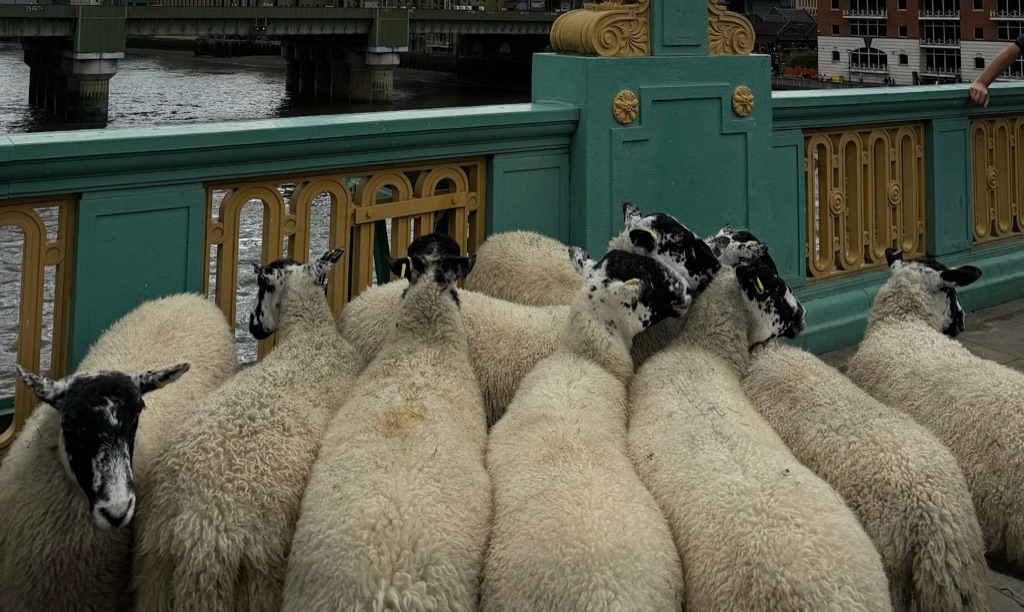
- Since medieval times, Freemen of the City of London had the right to drive their sheep across London Bridge without paying a toll. This tradition carries on today as a charity event.
- MuseumsTower Bridge is held together by around 13 million rivets.
- Tower Bridge’s high-level walkways were once considered so unpopular that they were closed. They shut in 1910 because pedestrians preferred waiting for the bridge bascules to come back down rather than climbing the stairs. They reopened in 1982.
- Each of Tower Bridge’s glass-floor panels is strong enough to support roughly an elephant — or two London black cabs.
- Tower Bridge has not always been red, white and blue. Its present patriotic colour scheme dates from 1977, when it was repainted for Queen Elizabeth II’s Silver Jubilee.
- Monuments & RuinsThe Monument to the Great Fire (1666) was designed to be 202 feet tall — it stands 202 feet west of where the fire began on Pudding Lane.
Hidden and Civic London
- The Monument was intended to double as an enormous scientific instrument. Christopher Wren and Robert Hooke planned to use the column as a zenith telescope connected to a laboratory beneath it. The experiment proved impractical due to the vibrations from the bustling area.
- London’s Monuments & RuinsGuildhall Roman Amphitheatre was lost for centuries and rediscovered only in 1988. Archaeologists found it beneath the ArtGuildhall Art Gallery site.
- That amphitheatre may once have held around 7,000 spectators. Romans gathered there for entertainment including animal fights, executions and gladiatorial combat.
- You can see its shape without going underground. The curved line of dark paving in Power & PoliticsGuildhall marks the outline of the Roman arena below.
Law & Order
- Policing in London began at Bow Street, eighty years before the Metropolitan Police. In 1749 the magistrate Henry Fielding - better known for writing Tom Jones - put together a handful of constables at his court to run down criminals across the city, and they became the Bow Street Runners.
- The station they worked from is a museum now, with its cells as they were. Oscar Wilde was charged at MuseumsBow Street Museum of Crime and Justice in 1895, and Dr Crippen, Roger Casement, the suffragettes and the Kray twins all passed through it; the station closed in 1992 and the court in 2006.
- NeighbourhoodsThe City has its own police force. The City of London Police is operationally separate from the Metropolitan Police and is the UK’s smallest territorial force by area.
- The Old Bailey is built on top of the prison that fed it. Newgate stood on the same ground, and until 1868 the condemned were hanged in the street outside in front of enormous crowds. The prison came down in 1902 and the Power & PoliticsOld Bailey opened over its site in 1907.
- “Clink” was a place before it was a word. The Bishop of Winchester’s prison on Bankside, in the liberty that carried its name, held debtors, priests and the people of the Bankside theatres from the twelfth century until it burned in the Gordon Riots of 1780, and the MuseumsClink Prison Museum.
- The civil courts were given a cathedral. G. E. Street’s Power & PoliticsRoyal Courts of Justice opened on the Strand in 1882 with a stone Great Hall and a thousand rooms, and the hall is open to walk into on a working day.
London’s peculiar government
- London effectively has two mayors. The Mayor of London governs Greater London strategically, while the City of London has its own separately elected Lord Mayor.
- The first recorded Mayor of London took office in 1189. His name was Henry Fitz-Ailwyn.
- The City elects a new Lord Mayor for a one-year term. Historically, some people tried to avoid the office because holding it could be extremely expensive. There was no salary, and Lord Mayors were expected to personally fund civic events, banquets and parades.
- One of the ceremonies installing the Lord Mayor is conducted almost entirely in silence. Appropriately, it is called the Silent Ceremony and has roots stretching back more than 800 years.
- The City of London, often known as the Square Mile, is the ancient core from which modern London developed. It remains a separate local-government area alongside London’s 32 boroughs.
Parks, trees and unexpected wildlife
- Pelicans have lived in Outdoors & NatureSt James's Park and Green Park since 1664. The first pair arrived as a gift to Charles II from the Russian ambassador.
- In 2026, pelicans bred in the park for the first time in more than 360 years. Four chicks hatched.
- More than 630 red and fallow deer roam freely in Outdoors & NatureRichmond Park. Deer have lived there since Charles I enclosed the park in 1637.
- London contains an estimated 8.4 million trees. That is close to one tree for every Londoner.
- Almost half of London looks green or blue from above. When private gardens, trees, water, verges and green roofs are included, almost 50% of the capital is green and blue space; London also contains roughly 3,000 parks.
Kew, zoos and natural history
- Outdoors & NatureRoyal Botanic Gardens, Kew holds the Guinness World Record for the largest living plant collection at a single-site botanic garden. When the record was awarded, the collection represented about 16,900 plant species.
- More than 50,000 living plants grow at Kew Gardens, spread across its 320-acre site.
- Kew’s scientific collections contain more than 8.5 million items. Its herbarium alone holds around seven million preserved vascular-plant specimens.
- Science & EngineeringLondon Zoo opened in 1828 as the world’s first scientific zoo. Initially it existed primarily for scientific study rather than ordinary public recreation.
- London Zoo helped popularise the word “zoo”, with the word emerging in London in the 19th century.
Greenwich, ships and time
- The red ball on top of the Science & EngineeringRoyal Observatory, Greenwich is a working time signal. Since 1833 it has dropped at exactly 1pm so that ships on the Thames could set their clocks accurately — and it still operates today.
- Greenwich became longitude 0° (prime meridian) by international agreement in 1884.
- Greenwich was selected partly because much of the world was already using it. By the 1880s, nearly two-thirds of ships were navigating with charts based on the Greenwich Meridian.
- MuseumsCutty Sark Museum is the world’s only surviving extreme clipper. During its merchant career it visited 16 countries and travelled a distance equivalent to about two-and-a-half return journeys to the Moon.
- The MuseumsQueen's House at Greenwich was revolutionary when it appeared. Inigo Jones’s seventeenth-century building is regarded as the first fully Classical building in England; its Tulip Stairs are also the country’s earliest centrally unsupported spiral staircase.