A History of the London Pub
From medieval alehouses and coaching inns to gin palaces, Victorian compartments and the modern neighbourhood “third place”.
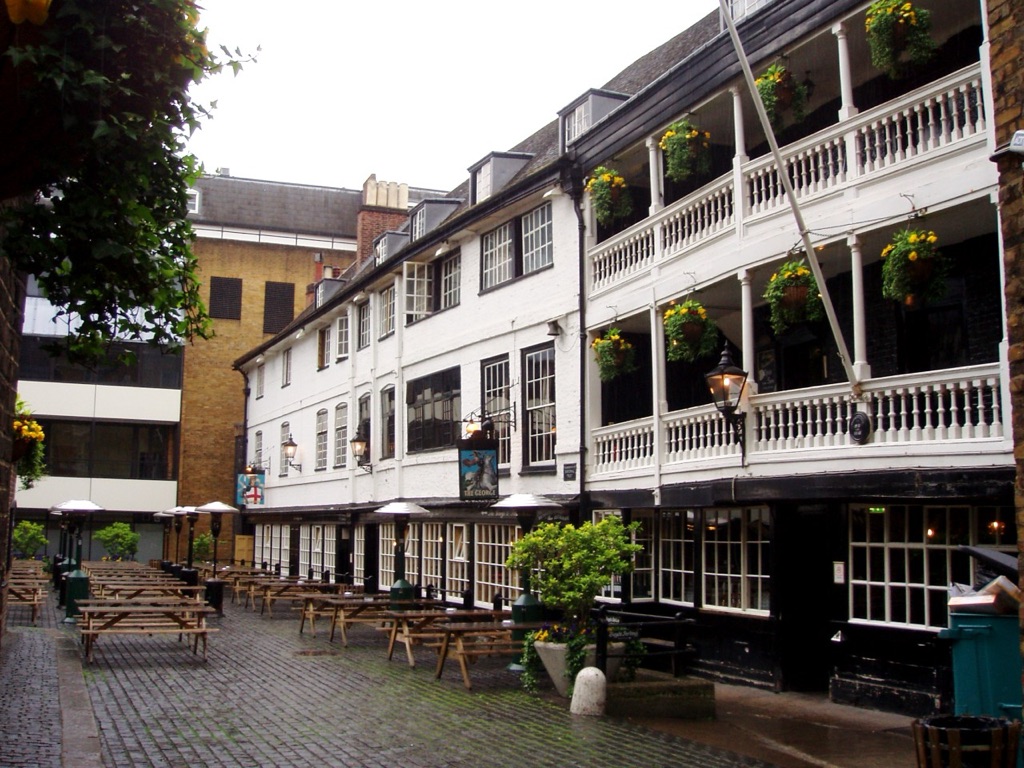
There is a good place in Southwark to begin a history of the London pub, because the building still explains what an inn once had to do.
Walk through the narrow entrance to the PubsThe George Inn on Borough High Street and the noisy street falls away behind you. Ahead is a courtyard; above it run timber galleries from which bedrooms once opened. Only one side of the old complex survives, but enough remains to understand the original arrangement. Travellers entered from the road with horses, baggage and goods. Coaches could stand in the yard. Stables and service buildings occupied the rear. Food and drink were available downstairs, while accommodation sat above. The George was not simply somewhere to buy alcohol. It was hotel, transport interchange, restaurant, warehouse, stable yard and meeting place gathered around one court. London’s last surviving galleried inn is a pub today because “pub” has gradually swallowed several older categories of drinking place that were once rather more distinct.
The distinction mattered. An inn principally served travellers and provided accommodation, food and stabling. A tavern was more strongly associated with wine and with urban commercial life. An alehouse was the humbler neighbourhood drinking place, selling ale or beer and often emerging from an ordinary domestic house. Later came the beerhouse, the gin shop and innumerable variations between them. By the nineteenth century these different traditions were increasingly gathered under the wonderfully literal expression public house: a house licensed for members of the public to enter and drink. The modern pub inherited pieces of all of them.
That is worth remembering when somebody points to a seventeenth-century building and calls it “London’s oldest pub”. The claim is often much less straightforward than it sounds. A site may have sold drink for centuries while the present building is Victorian. An ancient inn may have been rebuilt after a fire. A house may have become a pub long after it was constructed. Names migrate between buildings and are sometimes revived precisely because antiquity is commercially attractive. The PubsCittie of Yorke in Holborn makes the problem unusually visible: a drinking establishment has occupied its site for centuries, but the extraordinary mock-medieval hall in which people drink today was built in 1923–24. It feels ancient because somebody in the twentieth century wanted it to.
The deeper history is not really about identifying one oldest survivor. Places for communal drinking existed long before the word pub. The Romans brought their own drinking and dining culture to Londinium, together with wine imported from across the empire. Amphorae excavated in London preserve evidence of wines arriving from Italy, France, Greece and elsewhere; the MuseumsLondon Museum has even identified evidence for an unsuccessful experiment in wine production on the northern outskirts of Roman London in the first century. Wine was therefore part of London drinking culture since the establishment of the city itself.
After Rome, ale became deeply embedded in everyday English life. Brewing was initially a small-scale activity, often carried out within households, inns and alehouses rather than in the industrial breweries that later dominated London. Malted grain, water and yeast produced a drink that supplied calories as well as alcohol. Before hops became normal as a flavouring agent, English ale was generally unhopped, although other botanicals, roots, herbs, and spices might were used for flavouring. “Beer” initially carried a more continental meaning: a hopped drink associated especially with the Low Countries and German-speaking Europe. Only gradually did the old linguistic distinction collapse until beer became the general English word and ale a particular family within it.
This is also where one of the most persistent stories about the past needs correcting. It is often said that medieval people drank ale because the water was too dangerous to drink. London’s water could certainly be filthy. Rivers, wells and shallow groundwater existed in a city containing animals, cesspits, industries and rubbish, and contaminated sources undoubtedly caused illness. But medieval Londoners also deliberately sought out clean water and invested considerable resources in obtaining it. By the thirteenth century the City had constructed conduits bringing spring water into London; later systems carried water from sources including the River Westbourne. Contemporary records distinguish better and worse sources, and ordinary people demonstrably drank water.
Ale was popular because people liked ale. It was nourishing, socially important, commercially available and sometimes safer than a questionable water source, but it was not a medieval substitute for a substance nobody dared consume. The distinction matters because otherwise the history of the pub begins as an accident of bad sanitation. In reality, communal drinking became deeply established because it fulfilled social and economic functions as well as physiological ones.
Wine occupied a different part of the drinking economy. Medieval England imported large quantities from the continent, particularly from Gascony and Bordeaux. The political relationship between the English Crown and Aquitaine after the marriage of Henry II and Eleanor of Aquitaine created an unusually strong connection with the wines of south-western France, and London became a major market for what the English called claret. By the seventeenth and eighteenth centuries wine merchants, taverns and cellars formed an important part of the City and West End drinking world. Britain never had to choose culturally between beer and wine: beer became the everyday domestic drink, while imported wine retained stronger associations with trade, dining, status and particular kinds of establishment. London’s continuing fascination with Bordeaux has medieval roots.
The introduction of hops transformed the beer side of the story. Hopped beer had long been brewed in continental Europe, while traditional English ale remained unhopped. Imported hops were being used in London by the fifteenth century, and hop cultivation subsequently developed strongly in Kent. The geography was ideal for the capital: Kentish farms could supply a vast London brewing industry along the roads and river routes leading into Southwark and the City. Centuries later, thousands of Londoners would still travel into Kent for the annual hop harvest, turning seasonal agricultural labour into a curious East End tradition that survived into the age of mechanisation.
Hops changed both flavour and storage. Their bitterness countered the sweetness of malt, while their preservative qualities helped beer remain usable for longer. The result was not a sudden transition from ale to a new drink. Brewing traditions overlapped, terminology shifted and brewers experimented. England gradually developed a distinctive family of warm-fermented beers — brown ales, pale ales, milds, porters and eventually India pale ales — quite different from the cold-fermented lagers that later came to dominate much of central Europe. The now familiar sight of a London bar offering both cask bitter and Czech or German lager therefore represents two brewing traditions that developed along substantially different historical paths.
London eventually produced a beer style of its own. During the eighteenth century, the capital’s rapidly expanding population created enormous demand for the dark brown beers brewed locally. A stronger, matured form became particularly associated with the labourers carrying goods around London’s streets, markets and docks: porters. The beer took their name. Its stronger versions were known as “stout porter”, eventually shortened simply to stout. Porter became extraordinarily successful, and its production encouraged brewing to move from small premises into some of the largest industrial plants in the world.
The scale became spectacular. Whitbread operated from Chiswell Street; Truman’s Black Eagle Brewery expanded beside Beautiful StreetsBrick Lane; Barclay Perkins grew from the Anchor Brewery on Bankside; enormous breweries appeared at locations including Tottenham Court Road and Bow. The Barclay Perkins site in Southwark could claim to be the largest brewery in the world, while Truman’s was producing around 200,000 barrels of porter annually by the 1830s. Brewing had become heavy industry. Malt arrived in huge quantities, beer matured in gigantic vats, horses hauled barrels through London and brewery complexes became landmarks almost comparable in size to railway stations.
The danger of such scale was demonstrated horribly in 1814, when a great vat at Meux’s Horse Shoe Brewery near Tottenham Court Road burst. The failure triggered other vessels and released a torrent of beer into the surrounding streets. Buildings collapsed and eight people died. The London Beer Flood has acquired a slightly comic name, but there was nothing comic about the event for the poor families living around the brewery. It illustrates how thoroughly brewing had changed: the ale once made in kitchens and small brewhouses was now being stored in quantities capable of destroying houses.
The place where Londoners consumed all this drink was changing too. The medieval inn had developed around the movement of people. Borough High Street became one of the great concentrations because London Bridge (the only bridge crossing until 1750) funnelled travellers arriving from Kent, Surrey, Sussex and the Channel ports towards the City. The Tabard, White Hart, George and their neighbours provided beds, food, drink, horses, stables and space for business. Chaucer could therefore begin The Canterbury Tales at the Tabard without needing to explain why a collection of strangers would naturally assemble there before travelling south.
The later coaching inn made the transport role more systematic. Stagecoaches linked London to provincial towns, and large inns became points of departure and arrival. Courtyards allowed coaches to enter away from the street; galleries gave access to bedrooms above; stable yards supported the horses on which the entire network depended. Coaching inns also became centres for mail, parcels, information and commercial transactions. Their decline was correspondingly dramatic when railways began moving people faster and more reliably during the nineteenth century. Some disappeared entirely; others survived by becoming ordinary pubs or hotels. The George survived, partly amputated, after the railway companies acquired and demolished much of the surrounding property. What looks picturesque today is the remaining fragment of an infrastructure system made obsolete by another one.
Alehouses were different. They belonged primarily to neighbourhood life rather than long-distance travel. This made them socially useful and politically suspect. Authorities repeatedly attempted to regulate drinking establishments because they were places where people gathered beyond the immediate supervision of church, employer or household. Licensing was therefore never concerned only with alcohol. It was also concerned with disorder, gambling, crime, prostitution, political conversation and the general anxiety produced when ordinary people assembled in semi-private rooms.
The sign outside developed partly within this regulatory world. A famous order of 1393 required establishments selling ale to display the customary sign so that official ale tasters could find them and inspect what was being sold. This is more precise than the familiar claim that pub signs were invented simply because the population could not read. In a society with limited literacy, a painted White Hart or Red Lion obviously offered a useful visual identifier, but signs also made licensed premises legible to officials and customers alike. The image came first; the spoken name naturally followed.
The result is a surviving bestiary of English history. Red Lion, White Hart, Crown, Bell and Royal Oak remain among the most common historic pub names. Some referred to royal badges or heraldry, others to religion, trades, local landmarks or prominent landowners. Political change could alter the fashion: royal imagery became useful expressions of loyalty, while religious names sometimes changed after the Reformation. A pub name was effectively an address before streets were reliably numbered. Even today, saying “meet me at the Red Lion” preserves a system of urban identification older than the modern postal address.
During the seventeenth century, the alehouse and tavern acquired a remarkable new competitor. London’s first coffee house is conventionally dated to 1652, and the new drink spread through the capital with extraordinary speed. Coffee houses offered many of the things drinking houses already provided — warmth, company, conversation and a room in which to linger — but without making alcohol the organising principle of the establishment. For the price of a dish of coffee, customers could encounter newspapers, pamphlets, commercial intelligence and other people with whom to discuss them.
They became one of Restoration (post-1660) London’s characteristic social institutions. Robert Hooke used coffee houses for meetings connected with science, surveying and map-making; writers gathered around places such as Will’s in Covent Garden; merchants and brokers congregated in establishments close to the ArchitectureRoyal Exchange. They were neither modern cafés nor perfectly democratic debating societies. Their clientele was overwhelmingly male, individual houses developed particular social and political characters, and the authorities repeatedly worried about the conversations taking place inside them. Yet they provided an unusually accessible arena in which business, news, politics and sociability could mix.
The most consequential example was Edward Lloyd’s coffee house, established in the City in the late seventeenth century. Captains, merchants, shipowners and men prepared to insure their voyages gathered there because Lloyd cultivated reliable maritime intelligence. Ships and cargoes were discussed, risks were divided between underwriters and information circulated around the room. The coffee house eventually disappeared; ArchitectureLloyd's of London did not. One of the world’s great insurance markets can therefore trace its institutional ancestry to people meeting over coffee in a London room.
The coffee house deserves its own history because it represented a parallel answer to the same urban need that had produced the alehouse, tavern and inn. Londoners wanted places beyond the home where they could meet strangers, exchange information, conduct business and belong temporarily to a larger public world. The pub survived that competition and absorbed some of those functions itself, but for roughly two centuries the tavern and the coffee house stood beside one another as two of London’s most important forms of social infrastructure.
While the coffee house was creating a new kind of sober social space, another new drink was transforming London in a very different way. During the early eighteenth century the city experienced the extraordinary Gin Craze. Distilled spirits had previously been a relatively expensive drink, but economic policy, grain supply and taxation helped make gin astonishingly cheap and widely available. Small shops sold it with little of the social infrastructure associated with the traditional alehouse, and consumption became concentrated particularly among the urban poor. Contemporary observers linked it to poverty, crime, neglect and death — connections sometimes grounded in real misery and sometimes amplified by a wider moral panic over working-class behaviour.
No image did more to fix that panic in the imagination than William Hogarth’s Gin Lane of 1751. Hogarth presents St Giles as a neighbourhood collapsing both physically and socially. A drunken mother allows her baby to fall from her arms; a skeletal man shares a bone with a dog; buildings decay, somebody hangs from a garret and the pawnbroker flourishes while almost every productive trade has failed. Hogarth issued it alongside Beer Street, where well-fed workers drink the supposedly healthy national beverage in a prosperous neighbourhood. These are propaganda, not documentary photographs. They were produced in support of tighter control over spirits and present beer and gin as moral opposites with almost cartoon-like clarity. Their success is one reason the eighteenth-century Gin Craze can feel more visually real to us than many better documented aspects of London life.
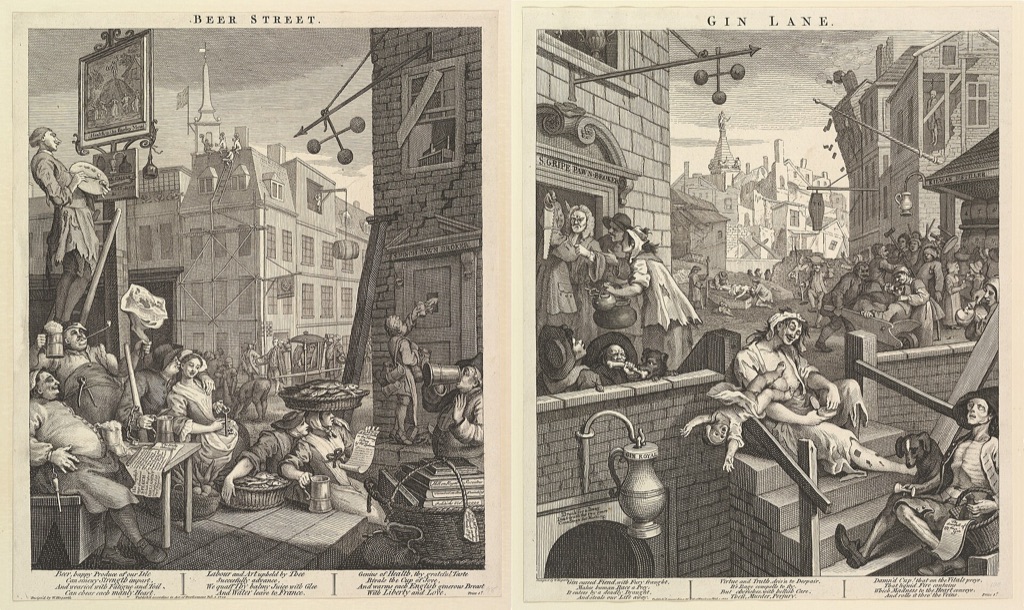
Parliament responded with repeated Gin Acts, culminating in the more effective legislation of 1751. Consumption eventually fell, but gin did not disappear. Instead it later returned wearing much better clothes.
The gin palace of the nineteenth century was almost the opposite of the degraded drinking shop Hogarth had imagined. New establishments competed through light, colour and display: plate glass, polished mahogany, mirrors, gas illumination, etched windows, decorative tiles and brilliant fittings. Their visual extravagance influenced the architecture of the Victorian pub more generally until “gin palace” became almost shorthand for an opulently decorated public house, whether or not gin was the principal drink. The decades around 1900 were the high point of this kind of pub building.
The PubsRed Lion, is one of the best places to see the result. Reworked in 1871, it retains etched and diamond-cut mirrors, mahogany, decorative glass and the traces of its old internal divisions. Three doors originally led into different bars. Rather than one large democratic room, the Victorian pub could be carefully stratified: public bar, private bar, saloon, tap room, smoking room and sometimes ladies’ room, commercial room or news room. The same landlord served all of them, but customers paid different prices and occupied different social spaces.
This is one of the most important things to notice in a genuinely historic pub interior. Victorian pubs were often compartmentalised. People were separated by class, purpose and sometimes gender behind wood-and-glass partitions arranged around a central servery. Multiple doors on an exterior are therefore archaeological evidence: they may reveal several former bars even where later owners have removed the internal walls. Frosted and etched glass provided light while limiting views between compartments. Mirrors made narrow rooms feel larger. Durable glazed tiles were easy to clean while also producing colour and shine. The familiar visual language of the “traditional London pub” — dark timber, mirrors, etched glass, brass and tile — was once conspicuously modern retail design.
The PubsPrincess Louise in Holborn preserves this theatricality magnificently. Its 1891 scheme combines polychrome tile, embossed glass, stained glass, mahogany and a central island bar. The compartments enclosing it today are partly a careful modern reinstatement rather than an untouched Victorian survival, but they restore the important historical idea that the pub was a collection of small rooms rather than a single drinking hall. Nearby, PubsThe Lamb retains its famous snob screens: movable etched-glass panels around the bar allowing customers to communicate with the barman while reducing unwanted visual contact with other drinkers. The name sounds almost satirical now; the mechanism belonged to a society that took social separation seriously enough to build it into furniture.
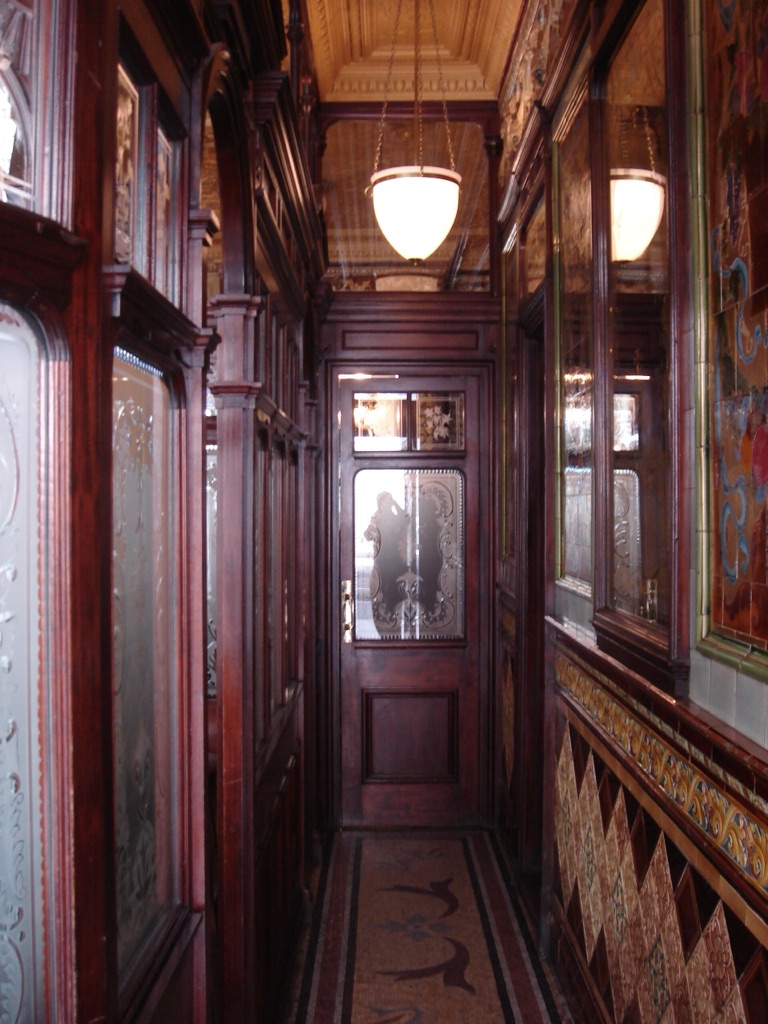
The PubsIsland Queen in Islington offers another clue to how the pub worked. Its late-Victorian interior is organised around a central island bar beneath iron columns, allowing staff to serve different rooms or compartments from the same core. In an era before electronic tills, cameras or modern staffing systems, pub architecture helped the landlord supervise several groups of customers simultaneously. The bar was not simply furniture dropped into a room: it was the organising machine of the building.
The nineteenth century also brought an explosion in the number of simpler drinking places. The Beerhouse Act of 1830 was intended partly to break existing licensing monopolies, improve access to cheap beer and encourage beer drinking over spirits. The effect was extraordinary. Parliamentary records later calculated that more than 24,000 people obtained beer licences in the first year. Many beerhouses began in ordinary homes, with little of the architectural grandeur subsequently associated with pubs. The government had effectively made it much easier for a ratepayer to convert part of a house into a commercial drinking place.
This proliferation produced its own backlash. Licensing authorities tightened control again, temperance movements grew and politicians increasingly debated what a respectable drinking place ought to be. The question became architectural in the twentieth century. Brewers began developing the “improved” public house, particularly in new suburbs. Instead of a glittering urban gin palace designed around rapid drinking at several bars, the improved pub might resemble a substantial country house and contain dining rooms, gardens, billiards, function rooms and spaces intended to attract women and families.
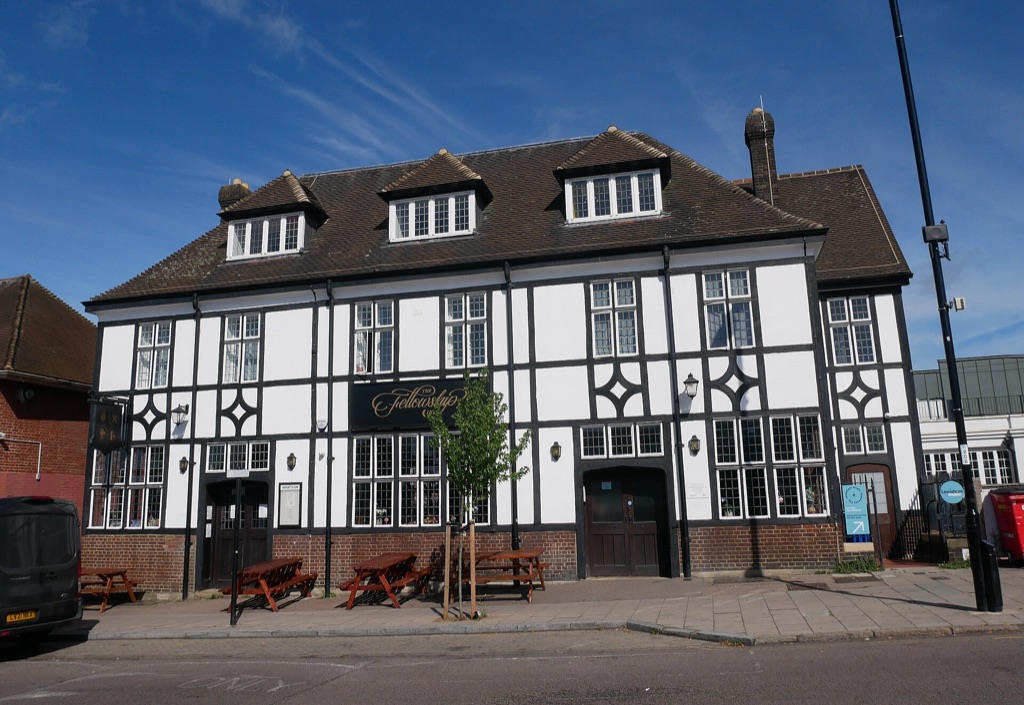
London’s suburban growth created opportunities for this new model. The PubsThe Fellowship Inn in Bellingham, built in 1923–24, is an especially interesting example because the London County Council had initially been reluctant to allow pubs on its housing developments under pressure from temperance opinion. When pubs were eventually admitted, the aspiration was not simply to replicate the hard-drinking city bar. They were increasingly expected to perform as respectable neighbourhood institutions. Historic England’s studies of the period describe restaurants, entertainment rooms and non-alcoholic refreshments becoming part of the programme. The pub was being deliberately redesigned as a social centre.
This helps explain something that can otherwise look like nostalgia. Twentieth-century pubs often adopted exaggeratedly old-fashioned architecture — half-timbering, steep roofs, inglenook fireplaces and the visual language of an imaginary country inn. By the early twentieth century the glittering gin palace itself was beginning to seem vulgar and urban. The replacement was sometimes what contemporaries called the “mock antique tavern”: a building designed to suggest that it had been serving villagers for generations even when the suburb around it had scarcely existed a decade earlier. The idea of the “traditional pub” was becoming an architectural product precisely because industrial modernity had made tradition desirable.
London breweries meanwhile became increasingly powerful landlords. For much of the twentieth century, the pub in which somebody drank was likely to be tied to a brewery that owned it and determined which beers could be sold. Names such as Whitbread, Watney, Truman, Courage, Charrington, Young’s and Fuller’s were written not merely on pumps but across the urban landscape. Brewery plaques, tiled fascias and signs turned pubs into a kind of distributed retail network. A neighbourhood might contain several pubs competing for customers while ultimately belonging to only a handful of brewing companies.
This system left traces everywhere. Truman’s enormous brewery still dominates part of Brick Lane although brewing ceased there in 1989. Young’s Ram Brewery in Wandsworth closed in 2006 after centuries of brewing on the site. Fuller’s Griffin Brewery at Chiswick remains active, although ownership of the beer business has changed. London’s brewing industry moved out, consolidated or disappeared, while many of the pubs it supplied remained behind. Their architecture can therefore preserve the vanished geography of the breweries that once owned them.
The beer itself changed too. By the late twentieth century, keg beer and nationally advertised brands had displaced much traditional cask-conditioned ale. Four drinkers founded the Campaign for Real Ale in 1971 in response. CAMRA’s achievement was cultural as much as technical: it encouraged drinkers to think of the pub, the cellar and the way beer is kept as things worth protecting. Its later inventories of historic pub interiors helped establish that bars, partitions, counters and fittings could possess heritage value just as churches and country houses did.
This recognition arrived just as many old interiors were disappearing. Pub rooms were opened into one another, bars replaced, etched glass removed and supposedly gloomy Victorian fittings stripped out in pursuit of larger and more flexible spaces. Historic England’s research stresses how rare genuinely intact old interiors now are. The irony is that the architectural features people currently seek out as the essence of the traditional London pub survived largely because nobody modernised them at the moment when modernisation seemed obviously desirable.
The modern pub has continued changing. The rigid hierarchy between public and saloon bars largely disappeared. Women ceased to be anomalous customers. Food moved from an optional accompaniment to a central source of revenue for many establishments. Televisions made sport part of pub culture; others deliberately rejected them. Quiz nights, comedy, live music, theatre and community meetings revived the old habit of using the pub for purposes beyond drinking. England’s indoor smoking ban in 2007 transformed the sensory environment again and pushed smoking into pavements, yards and gardens.
The beer behind the bar has simultaneously become more international. Cask bitter and stout coexist with continental lager, Belgian beer, Guinness, American-influenced pale ale, local craft beer and alcohol-free versions. London once imported hops from the Low Countries to make a foreign style called beer; centuries later its breweries imported American hop varieties and continental brewing ideas as part of another wave of reinvention. The distinction between foreign and native drinking culture was never as clean as pub nostalgia likes to suggest.
And yet something unusually durable remains.
A pub asks very little of the person entering it. You do not normally need a reservation, membership or invitation. You can stay for twenty minutes or an evening. Buying one drink establishes a temporary right to occupy a piece of warm, furnished space in an expensive city. Strangers can be present without having to introduce themselves. Friends can meet without inviting one another into their homes. A person can sit alone without necessarily appearing lonely. In sociological language it resembles a third place, somewhere between home and work; in London it developed the role centuries before anyone needed a term for it.
That freedom has always had limits. The supposed universal public house historically excluded or discouraged people according to class, gender, race and respectability, sometimes formally and sometimes through custom. Victorian architecture itself demonstrates those distinctions in the physical separation of rooms. Even today no pub is socially neutral. Each develops a clientele, price level, rhythm and unwritten set of expectations. But that is partly why London’s pubs are so revealing. They are tiny institutions through which larger changes in the city become visible.
Look again at the pubs listed on find.london and they begin to form a compressed architectural history. The George Inn preserves the travelling world of the coaching inn. The Red Lion shows Victorian pub-fitting at its most dazzling. The Princess Louise reconstructs the compartmented drinking culture of the late nineteenth century. The Lamb preserves the extraordinary etiquette embodied in snob screens. The Island Queen demonstrates the organising logic of the island bar. The Cittie of Yorke shows something different again: the twentieth century inventing an idealised medieval pub for itself.
None is valuable simply because it is old. What makes the best London pubs interesting is that the building still carries evidence of how people once used it.
The galleries tell you that travellers slept upstairs. Multiple front doors tell you that customers were once separated. Etched glass tells you that privacy mattered. A central servery reveals how one landlord controlled several rooms. Brewery lettering tells you who owned the beer supply. A large garden or dining room may reveal an inter-war attempt to turn drinking into respectable family recreation. Even the familiar painted sign hanging over the pavement belongs to a system of identification older than numbered streets.
This is also why a pub can survive repeated reinvention without ceasing to feel like a pub. The medieval alehouse, Georgian tavern, coaching inn, gin palace, beerhouse, Victorian public house and suburban roadhouse were never identical institutions. The modern pub is their descendant rather than their replica.
It no longer needs to stable your horse. It probably does not brew its own beer, and the wine may have come from New Zealand rather than Gascony. Nobody is required to identify the building from a painted White Hart because they cannot read the street name. Water comes safely from the tap, while alcohol-free beer comes from the bar.
But the underlying transaction remains remarkably familiar. You walk in from London. For the price of a drink, you temporarily belong somewhere.